HVAC Actuator Diagnosis
Clicking noises behind the dash, temperature changes that won't respond to controls, and air coming from the wrong vents are often caused by failed HVAC actuators.
Learn More →
Call Us:
615-946-2079 

Automotive HVAC System Diagnosis
One of our customers from South Florida summed up automotive air conditioning better than any textbook ever could.
"It's not convenience or comfort at this point, it's survival."
Anyone who has spent a summer in Tennessee understands exactly what he meant.
At Rock Bridge Automotive Repair, we diagnose and repair automotive heating, ventilation, and air conditioning systems (HVAC systems) on domestic and import vehicles. Whether your air conditioner isn't cooling, your heater isn't heating, your windows won't defrost properly, or your climate control system is behaving strangely, proper diagnosis is the key to a lasting repair.
We also believe customers deserve to understand how these systems work. Some of the information on this page is written for vehicle owners. Some of it is written for the apprentice technicians we train. If you'd like to learn more about how automotive HVAC systems actually work, you'll find several "Want To Get Technical?" sections throughout this page.
One of the first lessons many technicians learn is that there is no such thing as cold.
There is heat, and there is a lack of heat. Every automotive air conditioning system ever built, whether it uses R-12, R134a, or R1234yf, operates under that same principle.
Home air conditioners and HVAC units operate exactly the same way. Freezers and refrigerators work exactly the same way as well, but are designed for temperatures to be lower.
The purpose of an automotive air conditioning system is not to create cold. The purpose is to remove heat from the passenger compartment and transfer it somewhere else.
Every component in the HVAC system is working toward that goal.
The better the system removes heat from the passenger compartment, the more comfortable the occupants become.
Understanding this simple concept helps both customers and technicians understand why air conditioning systems sometimes fail and why proper diagnosis is so important.
Many people use the terms "air conditioning system" and "HVAC system" interchangeably, but they are not exactly the same thing.
The air conditioning system consists of components such as the compressor, condenser, evaporator, refrigerant, hoses, and expansion devices.
The HVAC system includes all of those components plus the heater core, blend doors, mode doors, actuators, sensors, control modules, and airflow management systems hidden inside the dashboard.
A vehicle can have a perfectly functioning refrigerant system and still leave the occupants uncomfortable because of a failure elsewhere in the HVAC system.
That distinction becomes very important during diagnosis.
One of the best examples of why HVAC diagnosis matters involved a Porsche 996.
The customer complained that even with the air conditioner running, he felt like he was baking inside the vehicle.
The refrigerant charge was correct.
The compressor was operating correctly.
The low-side pressure was correct.
The high-side pressure was correct.
By every traditional gauge reading, the air conditioning system appeared healthy.
Yet the customer was miserable.
For months, small pieces of foam had been blowing from the vents. The blend-door seals inside the HVAC housing had deteriorated and heated air was bypassing the blend doors and mixing with the conditioned air.
We measured the interior temperature.
It was 107°F.
The air conditioning system was operating correctly. The refrigerant charge was correct. The pressures were correct. Yet the passenger compartment was still 107°F!
The customer looked at us and said:
"I think that I actually look like burnt toast."
The customer then looked at me and said:
"I need a new air conditioning system, Joe."
We checked out the system. The refrigerant system had not failed. The pressures were perfect and the evaporator coil temperature was 39° in the scanner data.
The HVAC system had failed. The refrigerant system had not.
The customer doesn't care what the gauge readings are. The customer cares whether they are sweating through their shirt while sitting in traffic.
The heater had won the battle. That vehicle holds about seven gallons of 195° coolant at about 8 pounds per gallon. The a/c system holds about one pound of refrigerant. If the flaps in the dash malfunction the heater is going to win that battle every time
(When you run your defroster in the winter time, the vehicle turns on the a/c compressor to dry the air out but your heater has no problem making sure that the air on the windshield is still very warm).
This is one reason we diagnose the entire HVAC system instead of simply looking at refrigerant pressures.
Years ago, one of our younger technicians looked at an air conditioning estimate and said:
"$1,200 for a luxury? That's ridiculous."
The next day the customer came back.
She was a high-level executive preparing to present a multi-million-dollar business proposal. Her air conditioning system had failed during the hottest part of the year. Her makeup had run down her face and she was absolutely furious.
She looked directly at the technician and said:
"I have a three million dollar proposal this morning and I look like a friggin' sad clown. You think my air conditioner is a luxury and not a necessity? Roll your windows down and don't try to go further in life."
The lesson stuck.
For some people, air conditioning is comfort.
For others, it affects visibility, concentration, professionalism, safety, and the ability to perform their jobs effectively.
In Middle Tennessee, South Florida, and many parts of the South, air conditioning is often much more than a luxury item.
The next few sections are written for apprentice technicians, curious customers, engineers, maintenance professionals, and anyone who wants a deeper understanding of how automotive air conditioning systems actually work.
This explanation occasionally makes HVAC engineers cringe, but it has helped countless customers and apprentice technicians understand how air conditioning systems work.
Most people think of the compressor as a device that creates pressure.
From a diagnostic standpoint, however, the low side of the system is where passenger comfort begins.
A healthy compressor creates a low-pressure environment inside the evaporator. That reduction in pressure allows refrigerant to change from a liquid into a gas. During that phase change the refrigerant absorbs large amounts of heat from the passenger compartment.
The low side is where the work gets done.
The high side is simply the consequence of creating that low-pressure environment.
As refrigerant vapor leaves the evaporator, the compressor must force it through the condenser where the heat can be removed and the refrigerant converted back into a liquid.
Years ago one of my instructors, Klaus Bittrauf, taught me to pay close attention to the low side of the system.
The low side creates passenger comfort.
The high side tortures the compressor.
That lesson has stayed with me throughout my career.
One of the most common mistakes technicians make is becoming obsessed with high-side pressure readings.
The customer sitting in traffic does not care what the high-side pressure is.
The customer cares whether they are comfortable.
If your system is perfectly charged and you're sitting there with approximately 45 PSI on the low side, an evaporator temperature around 55°F, and 65°F coming out of the vents, nobody in that vehicle is going to be happy on a Tennessee summer afternoon.
The gauges may look acceptable.
The customer is still sweating.
The customer doesn't care what the pressures are.
The customer cares whether they arrive at work looking professional or looking like a sad clown.
For many years automotive air conditioning systems operated very simply.
The compressor was either on or off.
When low-side pressure dropped low enough, the compressor cycled off. When pressure rose again, the compressor cycled back on.
Drivers could often hear the compressor clutch clicking on and off throughout the drive.
Modern vehicles frequently use variable displacement compressors. Instead of constantly cycling on and off, the compressor continuously adjusts how hard it works.
One of the easiest ways to understand a variable displacement compressor is to think about a helicopter.
Think of it as a helicopter pilot constantly adjusting blade angle instead of turning the engine on and off every few seconds.
Instead, the pilot changes the angle of the rotor blades.
The greater the blade angle, the more lift is produced.
The smaller the blade angle, the less lift is produced.
A variable displacement compressor works in a very similar way.
Inside the compressor is a swash plate. By changing the angle of the swash plate, the compressor changes how far the pistons travel during each revolution.
At maximum angle, the compressor moves a large volume of refrigerant.
At minimum angle, the compressor may move almost no refrigerant at all even though it is still spinning.
The HVAC controller continuously adjusts the swash plate angle to maintain cooling performance.
Instead of constantly cycling on and off, the compressor continuously adjusts how hard it works.
Variable displacement compressors introduced an entirely new diagnostic challenge.
A compressor can be spinning normally.
The refrigerant charge can be correct.
The vehicle can still cool poorly.
Why?
Because the compressor may not be operating at full displacement.
The compressor itself may be healthy while a control valve, pressure sensor, temperature sensor, controller, or command signal is preventing the compressor from increasing output.
Many repair facilities simply replace both the compressor and the controller because determining which component is responsible can be difficult.
We prefer diagnosis whenever possible.
"Well, we know that it's broke! But that's about all we know!"
Even with decades of HVAC experience and extensive diagnostic equipment, these compressors fooled me when they first became common.
Eventually I purchased specialized HVAC diagnostic equipment from Murray specifically to test variable displacement compressor systems.
Millions of vehicles use these compressors, yet many shops still replace compressors and controllers together because determining which component has actually failed can be difficult.
Today there are millions of vehicles on the road using this design.
Unfortunately, many technicians still struggle to distinguish between a failed compressor, a failed control valve, a failed controller, or a failed sensor input.
Because the symptoms can be similar, parts are often replaced without conclusive testing.
At Rock Bridge Automotive Repair, we invested in specialized HVAC diagnostic equipment designed specifically to evaluate these systems. With literally millions of vehicles running these systems, it made perfect since to me to go ahead and purchase diagnostic equipment to make sure that we could accurately diagnose themand show the customers that we are only replacing or repairing exactly what they need.
Proper testing helps us determine whether the compressor is incapable of producing displacement or whether the control system is preventing it from doing so.
Diagnosis is almost always less expensive than guessing.
When I first began working on automotive air conditioning systems, condensers looked very much like radiators.
Manufacturers would take a tube, flatten it, add cooling fins, and use that assembly to remove heat from the refrigerant.
The systems worked well, but they required relatively large amounts of refrigerant and often operated with fairly high discharge pressures.
Then came the late 1990s.
Government regulations pushed manufacturers to reduce refrigerant usage. Engineers went back to the drawing board.
What they created changed automotive HVAC systems forever.
Instead of using a few large flattened tubes, manufacturers developed what are commonly called parallel-flow condensers.
These condensers contain numerous tiny passages that dramatically increase the amount of metal touching the refrigerant.
The result was significantly improved heat transfer efficiency.
Many technicians were skeptical when we first learned about them.
The manufacturers were claiming enormous efficiency gains.
What convinced us was the refrigerant capacity.
Systems that once held approximately three pounds of refrigerant suddenly required about one pound.
The condensers were simply doing a much better job of removing heat.
Remember what Klaus taught:
The low side creates comfort.
The high side tortures the compressor.
The more efficiently a condenser removes heat, the less work the compressor must perform.
Lower discharge temperatures mean lower operating pressures.
Lower operating pressures mean less stress on compressor components.
Less stress usually means longer compressor life.
I still have a compressor in my personal Ford Ranger with more than 300,000 miles on it producing excellent cooling performance.
Maybe not all engineers should be hung after all.
This is one of the most common questions customers ask.
"Why can't we just flush the condenser?"
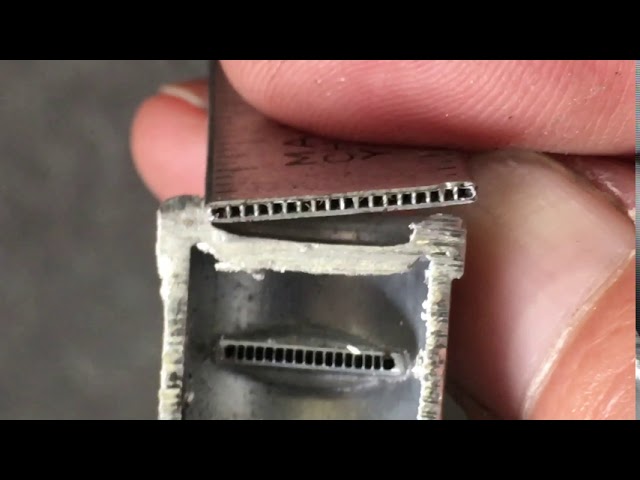
For years now, I have kept cutaway condensers around the shop specifically to answer that question.
My employees eventually started joking when they saw me heading toward the waiting room carrying one.
They knew exactly what was coming.
I'd walk up to the customer and say:
"Ma'am, I need you to look at this."
The moment customers see the inside of a modern condenser, everything suddenly makes sense.
The same tiny passages that make modern condensers incredibly efficient also make them extremely effective at trapping debris from a failed compressor.
When a compressor fails internally, metal particles can be distributed throughout the refrigerant system.
Many of those particles become trapped inside the condenser.
Installing a new compressor into a contaminated condenser risks sending that debris directly into the replacement compressor.
That's why many manufacturers recommend condenser replacement after major compressor failures.
The conversation usually changes quickly from:
"Why are we replacing the condenser?"
to:
"How could you ever get all of that out of there?"
Yes. Modern HVAC systems include blend doors, actuators, climate control modules, and heater components in addition to the refrigerant system. A vehicle can have correct refrigerant pressures and still have poor cabin comfort if another HVAC component fails.
The air conditioning system removes moisture from the air before it reaches the windshield. The heater then warms that dry air and directs it toward the glass. This helps clear fogged windows much faster.
Many modern vehicles use variable displacement compressors. Instead of cycling on and off, these compressors continuously adjust output to maintain cooling performance and improve efficiency.
Modern condensers contain extremely small passages that can trap debris from a failed compressor. Replacing the condenser helps prevent contamination from damaging the replacement compressor.
This condition is commonly caused by a blend door, actuator, climate control, or HVAC control problem. Refrigerant issues can also contribute, but proper diagnosis is needed to determine the cause.
Low refrigerant is only one possible cause of poor cooling performance. Compressors, condensers, evaporators, blend doors, actuators, sensors, and climate control systems can all affect HVAC operation.
More Information
Here are links to some of the other repair pages on my website.
HVAC System Resources
Modern automotive HVAC systems involve much more than refrigerant and compressors. Learn about blend doors, climate controls, heater performance, evaporators, condensers, and the systems that keep you comfortable throughout the year.
Clicking noises behind the dash, temperature changes that won't respond to controls, and air coming from the wrong vents are often caused by failed HVAC actuators.
Learn More →Poor cabin heat can be caused by low coolant levels, restricted heater cores, thermostat issues, air pockets, or blend door problems.
Learn More →When the heater wins the battle, blend doors are often the culprit. Learn how HVAC doors control airflow and temperature inside your vehicle.
Learn More →Automatic climate control systems rely on sensors, actuators, modules, and controllers working together to maintain passenger comfort.
Learn More →Learn how compressors, control valves, and variable displacement systems work and why proper diagnosis matters.
Learn More →Modern condensers and evaporators are highly efficient but can create unique diagnostic challenges after system failures.
Learn More →Brands We Service



















© Copyright 2026, Rock Bridge Automotive Repair | Honoring America’s 250th Anniversary